August 5, 2026
AI vs Human Support: Finding the Right Balance
Learn how to combine AI and human support to improve response times, customer experience, and operational efficiency.
AI vs Human Support: Finding the Perfect Balance
Customer support is no longer just a service function. It is a direct reflection of how a business operates, communicates, and earns trust. As companies adopt automation and AI, one question keeps coming up: what should be handled by AI, and what still needs a human touch?
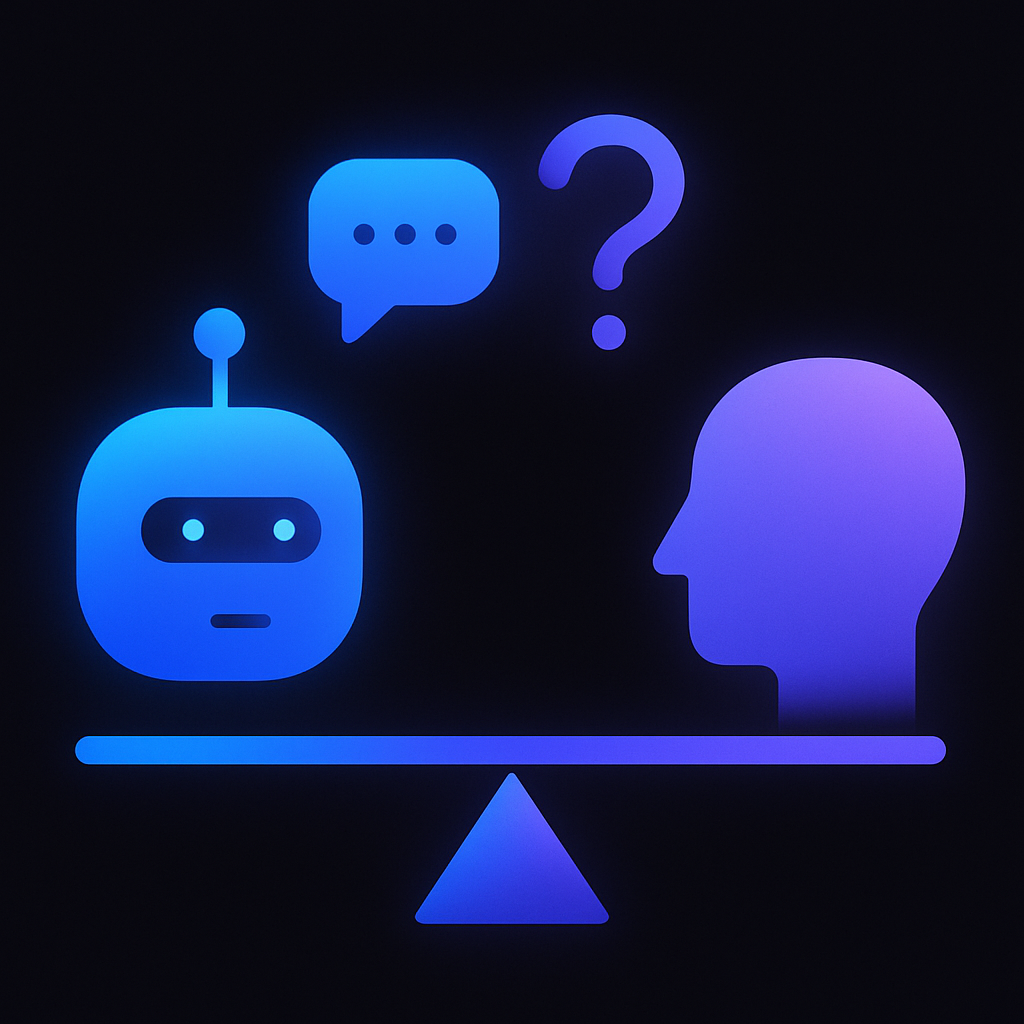
The answer is not either/or. The strongest support systems use AI and human teams together, each handling the work they are best suited for. Done well, this creates faster responses, better consistency, and more meaningful customer experiences.
Why the AI vs Human Support question matters
Support expectations have changed. Customers want quick answers, accurate information, and easy resolution across channels. At the same time, businesses need to control costs, reduce repetitive work, and maintain service quality as they grow.
AI makes it possible to scale support without scaling headcount at the same pace. It can sort tickets, answer common questions, summarize conversations, and route requests to the right place. Human agents, on the other hand, bring judgment, empathy, and flexibility—especially when the issue is complex, emotional, or high-stakes.
The goal is not to replace people. It is to create a support model where routine work is automated and human expertise is reserved for the moments where it matters most.
What AI support does well
AI is highly effective when the task is repetitive, structured, and based on clear patterns. In customer support, that often includes:
- Answering frequently asked questions
- Providing order or account status updates
- Guiding users through basic troubleshooting
- Categorizing and prioritizing incoming tickets
- Suggesting responses for support agents
- Summarizing long conversation histories
- Handling after-hours triage and first responses
These capabilities make support faster and more consistent. AI does not get tired, does not forget a policy update, and can handle a large number of interactions at once.
For businesses, this means shorter wait times and less time spent on repetitive tasks. For customers, it means getting immediate help for straightforward issues instead of waiting in a queue.
Where human support still wins
Even with strong AI systems in place, human support remains essential. Some situations require context that AI may not fully understand, especially when a customer is frustrated, the issue is unusual, or the business impact is significant.
Human support is best for:
- Escalated complaints or sensitive situations
- Complex troubleshooting across multiple systems
- Exceptions to policy or process
- Relationship-building with high-value customers
- Situations requiring judgment, reassurance, or negotiation
Customers often do not just want an answer. They want confidence that someone understands the problem and can take responsibility for solving it. That level of trust is built through human interaction.
The real advantage: handoff, not replacement
The best support experience is usually not fully automated or fully manual. It is a well-designed handoff between AI and human agents.
AI should handle the first layer of support wherever possible. That includes gathering information, identifying urgency, resolving simple questions, and directing the conversation. When the issue becomes more nuanced, AI should pass the context to a human agent without forcing the customer to repeat everything.
This is where many support systems fall short. Poor handoffs create frustration. A customer starts with automation, gets transferred, and then has to explain the issue all over again. That experience feels disconnected.
A strong support model preserves context, reduces friction, and allows humans to step in exactly when needed.
Designing a support system that works
Finding the right balance starts with a clear view of your support operations. Not every business needs the same level of automation, and not every customer journey should be treated the same way.
Start by mapping your support requests into three categories:
1. Fully automatable
These are repetitive, low-risk requests with clear answers. AI can handle them end-to-end.
2. AI-assisted
These cases benefit from automation at the start, but a human should review, confirm, or finish the interaction.
3. Human-first
These are sensitive or complex issues where a person should lead from the beginning.
This framework helps businesses avoid over-automating. It also prevents support teams from spending time on tasks that software can handle more efficiently.
Practical takeaways
If you are evaluating AI in customer support, start here:
- Review your top support categories and identify repetitive questions.
- Automate only the requests with clear rules and low risk.
- Preserve conversation history so handoffs feel seamless.
- Give agents AI tools that help them respond faster, not just replace them.
- Measure success by resolution quality, not just response speed.
These steps create a support model that is efficient without becoming impersonal.
The role of AI in support operations beyond the front line
AI’s value is not limited to customer-facing chat. It can also improve the internal support operation itself.
Support leaders can use AI to analyze ticket trends, identify recurring issues, and reveal gaps in documentation or product design. AI can also help teams prioritize work based on urgency, customer impact, or historical patterns.
That operational layer matters. Better routing, better insights, and better internal workflows lead to faster resolution times and a better experience for both customers and support staff.
Balancing efficiency with trust
Businesses often approach AI support with a narrow question: how much can we automate? A better question is: how can we improve service without losing trust?
Trust is built through reliability, clarity, and accountability. AI contributes to reliability by making routine support faster and more consistent. Humans contribute accountability by handling exceptions, clarifying uncertainty, and creating confidence when it matters most.
The right balance is not static. It evolves as your business grows, your product changes, and your customers’ expectations shift. The companies that perform best are the ones that keep refining the relationship between automation and human expertise.
Final thoughts
AI and human support are not competitors. They are complementary tools in a modern service strategy. AI is ideal for scale, speed, and consistency. Humans are essential for judgment, empathy, and trust.
If you want better support outcomes, do not ask whether AI should replace human support. Ask where AI can remove friction, where humans create the most value, and how to connect both into one seamless experience.
That is where support becomes not just more efficient, but more effective.